







In the process of working with fiber optic or communication cables, there seems to be a constantly recurring question: What really distinguishes duplex from simplex armored cable? This article aims at highlighting simplex armored cables, their differences from the duplex, and shed more light on why these designs are still used to this day.

Understanding What is Simplex Armored Cable?
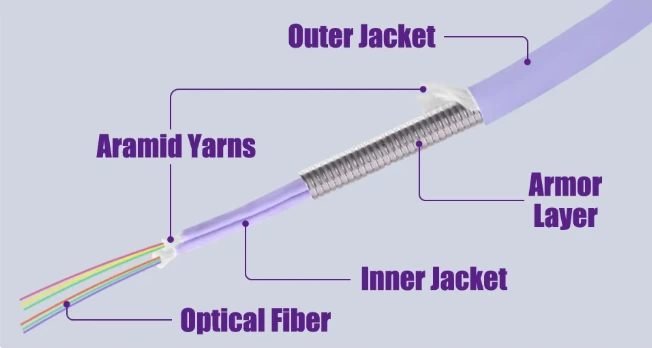
A simplex armored fiber cable has just one fiber core or transmission pathway within the cable structure. This is because the word “simplex” implies single-direction or single-channel connectivity. This type of cable differs from duplex cables, as the latter have two fibers for sending and receiving signals.
The “armored” portion refers to the fact that this type of cable has a metal covering, typically in the form of steel tape or wire. This metal covering helps protect the fiber against damage by pressure, rodents, and physical forces. It is because of this feature of simplex armored cable that it is typically installed in high-risk environments.
Simplex armored cable is often preferred for installations based on strength, support, and a clear signal route.

How different is the Duplex Armored Cable?
The best way to understand simplex armored cable is to make a direct comparison with duplex armored cable. The Duplex armored cable contains two fibers within the same jacket. The reason for this is that one fiber transmits data, while another receives data at the very same instant. This makes duplex designs suitable for full-duplex communications systems.
Whereas a simplex armored cable utilizes only one fiber. Communication can still be two ways, but it takes place in one direction at a time rather than both. In those systems where only one direction is needed or when the signals can be separated either by time or wavelength, simplex designs are sufficient.
This variation in jacket material and construction affects cable selection for use indoors or outdoors, in networks, industrial systems, or for other applications.

Common Uses Of Simplex Armored Cable
Simplex armored cable is widely used in situations where durability matters more than bidirectional speed. Simplex armored cable is normally installed between control rooms and equipment stations in industrial areas. The armoring protects from severe vibration, accidental impacts, and other harsh conditions that may arise.
For outdoor applications, Simplex armored cable is used for direct routing via conduits, wall routes, and underground routes. The armored portion diminishes the need for protective piping.
Usually, in security systems as well as monitoring systems, simplex cables are employed for transmitting signals in one direction. This includes data from sensors to the central unit. Due to its relatively simple internal composition, the simplex armored cable is also manageable during the installation process.
Installation and Handling Requirements
Installing simplex armored cable is relatively simple, but there are still factors to take into account.
- The armor member raises the stiffness of the cable. The minimum bending radius has to be taken into account by the person installing, in order not to damage the fiber.
- Termination also needs proper equipment. Armor needs to be cut properly and have grounding capabilities, depending on the settings, mainly in an industrial setting.
- As far as routing is concerned, simplex cables are easier to route than the duplex armored cable because of its smaller size and lower weight.
Cost and Maintenance Differences
Cost-wise, simplex armored cables are generally less expensive than duplex armored cables. There are fewer fibers with less complexity in constitution. The process of testing and monitoring a single fiber makes it simpler to detect any errors. This can simplify maintenance in crucial systems. In projects where cost control is relevant, simplex armor solutions are generally preferred without compromising on security.
Conclusion
The contrast between duplex and simplex armored cable lies in its structure, functionality, and requirements. This knowledge plays an important role in identifying the correct cable type to be used.