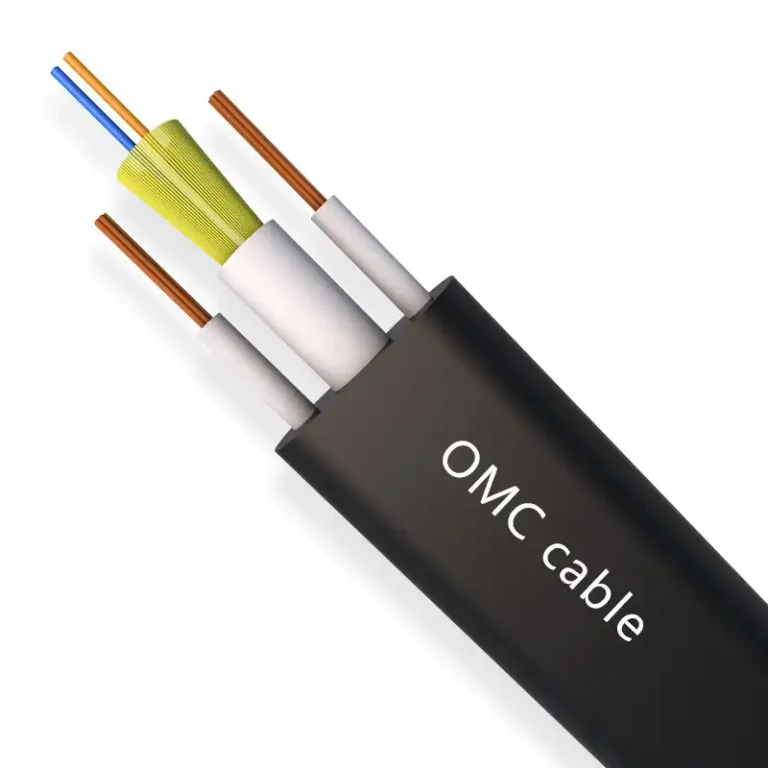







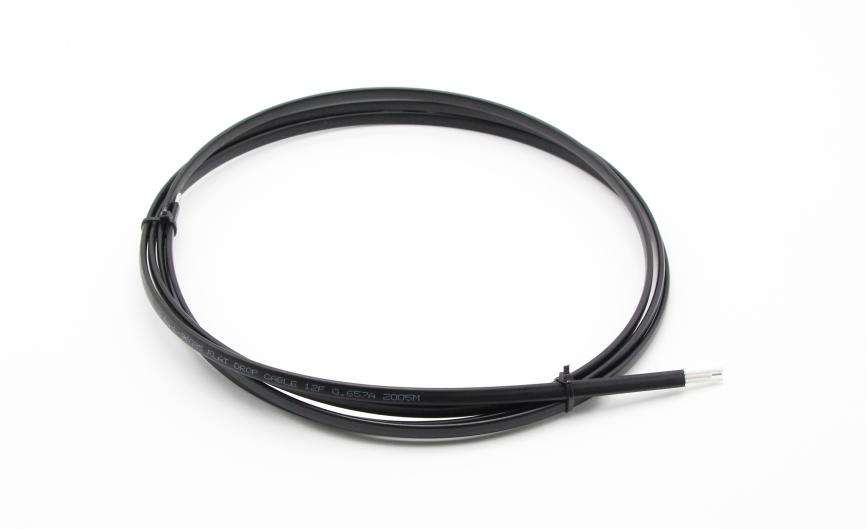
FTTH flat drop cables play a very essential role in today’s FTTH system in delivering the last-mile connection to the end-user from the telecommunications network. FTTH flat drop cables come in handy due to the ease of installation that results from their flat nature, allowing for hanging and dropping. Depending on various requirements, there are different types of FTTH flat drop cables, each with its own characteristics depending on where it is to be used. This article will explore the different classifications of FTTH flat drop cables and their respective use cases.
1. Single Mode Fiber Cable (SMF)
Single-mode fiber cables (SMF) are the most commonly used fiber type in FTTH flat drop cables when high bandwidth and long distances are involved in the application. This fiber cable is capable of transmitting signals over long distances with minimal loss of the signals, thus it is the best alternative in broadband communication and any other networks that require high bandwidth.
- Bandwidth: 10 Gbps and higher
- Transmission Distance: Over 10 km
- Loss: 0.35 dB/km (1550 nm wavelength)
- Application: Long-distance FTTH connection, Wide Area Network, large broadband network
2. Multi-Mode Fiber Cable (MMF)
MMF is often used in FTTH flat drop cables where the transmission distance is relatively short. Compared to single-mode fiber, it is cost-effective, although the distance over which it can transmit signals and the bandwidth are lower.
- Bandwidth: 1-10Gbps
- Transmission Distance: 300 m-2km
- Loss: 3.5 dB/km (850 nm wavelength)
- Application: LAN, small FTTH connection, data center
3. Low Smoke Zero Halogen (LSZH) Cable
The FTTH flat drop cables with an LSZH jacket are manufactured with eco-friendly materials that produce low smoke levels during combustion and contain no halogens. Such cables can be laid in places that require high safety standards.
- Bandwidth: Up to 10 Gbps, depending on the type of fiber (SMF or MMF).
- Distance Transmission: These cables are suitable for both short and long distance transmissions, depending on fiber types.
- Loss: Same as for the base fiber (SMF or MMF).
- Applications: High-safety zones, commercial buildings, transportation infrastructure.
4. Aramid Yarn Reinforced Fiber Cable
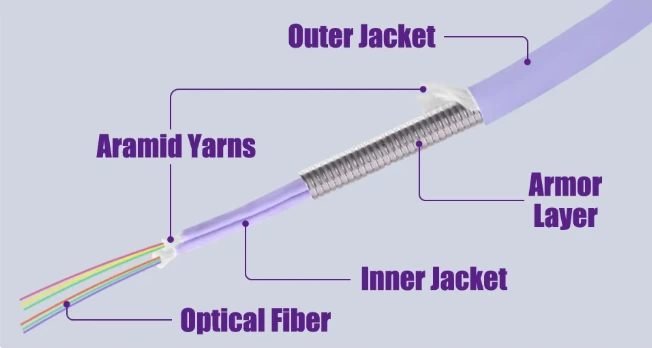
Aramid yarn reinforced fiber cables are characterized by added mechanical strength and can be used outdoors where increased tensile strength is needed. These FTTH flat drop cables are usually employed when installing fibers that require enhanced resistance to mechanical strain.
- Bandwidth: 10 Gbps and above (if using SMF) or 1-10 Gbps (if using MMF)
- Transmission Distance: Suitable for long-distance or short-range installations, depending on the fiber type
- Loss: Similar to SMF or MMF
- Applications: Outdoor installation sites, extensive residential areas.
5. Water-Blocking Fiber Optic Cable
The FTTH flat drop cable with a water-blocking jacket is made using special materials that resist moisture penetration. Thus, the cable will work fine in damp conditions, since moisture does not affect its optical properties.
- Bandwidth: 10 Gbps and higher (in case of SMF use) or 1-10 Gbps (in case of MMF use).
- Transmission distance: Can be used for both long-distance and short-range communications, depending on the type of fiber.
- Loss: 0.35 dB/km (in case of SMF use) or 3.5 dB/km (in case of MMF use).
- Applications: Buried laying, damp environment, areas with high moisture concentration.
The outdoor fiber optic string is among the most commonly used types of FTTH flat drop lines. It’s designed to be resistant to harsh environmental factors like ultraviolet light and harsh rainfall conditions. The string is generally boxed in a rainfall- evidence material similar to polyethylene( PE).
- Bandwidth: 10 Gbps and above (if using SMF) or 1-10 Gbps (if using MMF)
- Transmission Distance: Suitable for long-distance fiber links and outdoor FTTH connections
- Loss: 0.35 dB/km (for SMF) or 3.5 dB/km (for MMF)
- Application: Outdoor FTTH installation, long-distance fiber connection, and locations exposed to harsh weather conditions.
Comparison Table: FTTH Flat Drop Cable Types
|
Cable Type |
Bandwidth | Transmission Distance | Loss | Applications |
Environment |
|
Single-Mode Fiber (SMF) |
10 Gbps and above | >10 km | 0.35 dB/km (1550 nm) | Long-distance FTTH, WAN | Long-distance, large-scale |
|
Multi-Mode Fiber (MMF) |
1-10 Gbps | 300 m – 2 km | 3.5 dB/km (850 nm) | Short-range FTTH, LAN |
Short-range, data centers |
|
LSZH Cable |
Same as SMF or MMF | Same as SMF or MMF | Same as SMF or MMF | High-safety environments | Commercial, transport |
| Aramid Yarn Reinforced | Same as SMF or MMF | Same as SMF or MMF | Same as SMF or MMF |
Outdoor, high tensile strength |
Outdoor, rugged |
| Water Blocking Cable | Same as SMF or MMF | Same as SMF or MMF | Same as SMF or MMF |
Wet environments, underground |
Damp, underground |
| Outdoor Fiber Optic Cable | Same as SMF or MMF | Same as SMF or MMF | Same as SMF or MMF | Harsh outdoor conditions |
Extreme weather, outdoor |
Conclusion
There are numerous considerations when opting for the applicable FTTH flat drop lines. Single- mode fiber lines are recommended for operations that need advanced bandwidths over longer distances, while multi-mode fiber lines are more affordable for shorter distances. Other lines, similar to LSZH, water-resistant, and aramid yarn corroborated lines, will also ensure that the string will be installed safely and efficiently in different surroundings.
Optimizing your network’s performance and reliability requires the use of the proper FTTH flat drop cable that is suitable for your requirements. You can count on OMC to provide the best solutions for your network.