







Fibre-optic cables play a vital role in modern power and communication networks. Among them, ADSS cable and OPGW cable are widely used for transmitting data along overhead power lines. ADSS cable is lightweight and metal-free, while OPGW combines optical fibres with metal for grounding. This article explains the differences between the two cables and their key applications.

What is an ADSS cable?
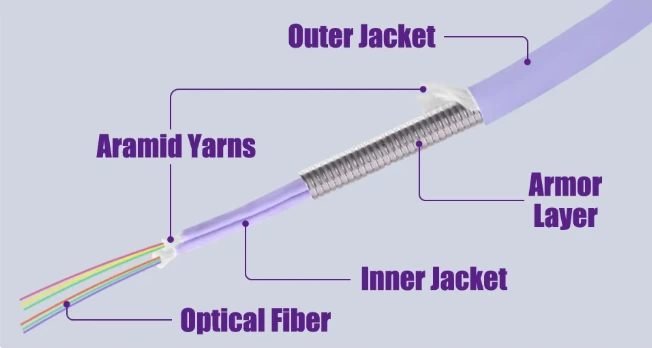
ADSS cable stands for All-Dielectric Self-Supporting cable. It does not have any metal parts and is a fibre-optic cable. This helps it to be lightweight and safe near live power lines. The cable includes strength members such as aramid yarn and a protective jacket. It can be suspended between poles or towers without additional support. ADSS cable is unaffected by electromagnetic fields. It transports data across long distances without being affected by or affecting nearby electricity.

What is OPGW cable?
OPGW is short for Optical Power Ground Wire. It is a fibre optic cable, but also includes metal strands. The metal gives the cable strength and serves as a ground wire to guard against lightning. The optical fibres are contained within a metal tube that is encased in steel and aluminium strands. OPGW is usually installed at the top of high-voltage towers. It can carry data and provide grounding at the same time. This cable is heavier than ADSS and needs careful installation.

Key Differences Between ADSS and OPGW
|
Feature |
ADSS Cable | OPGW Cable |
|
Construction |
Fully dielectric, contains no metal component | Includes metal strands for strength |
| Electromagnetic Interference (EMI) | Resistant to EMI, safe to install ear high voltage lines |
Conductive, sensitive to EMI, requires proper grounding |
| Purpose | Dedicated to fibre-optic data transmission |
Dual-purpose: carries data and functions as a grounding/lighting protection wire |
|
Mechanical Strength |
Lightweight and self-supporting | Strong due to metal reinforcement, heavier in weight |
|
Installation Position |
Mounted near power lines on supporting structures |
Positioned at the top of transmission towers as the grounding wire |
| Installation Difficulty | Relatively simple, minimal support structure needed |
More complex, it requires careful grounding and structural planning |
|
Durability & Environmental Resistance |
Resistant to UV, extreme temperatures and corrosion | Metal parts require corrosion protection, but overall robust |
|
Common Uses |
Data communication along power lines, railways, and highways |
High-voltage transmission, lightning protection, smart-grid communication |
| Safety | Non-conductive, lower risk of electric hazards |
Conductive, requires strict safety measures during installation and maintenance |
|
Cost |
Lower materials and installation costs | Higher cost due to materials and dual functionality |
|
Maintenance & Lifespan |
Long-lasting with minimal maintenance |
Needs periodic inspection for corrosion and upkeep |
| Future Developments | Lighter, more durable materials |
Smart-grid integration and hybrid cables like OPPC, combining optical and electrical conductors |
What Are the Advantages and Disadvantages of ADSS and OPGW Cables?
(1)ADSS Cable
- ADSS cable is non-conductive and safe to install near live power lines.
- It is immune to electromagnetic interference and has low material and installation costs.
- However, it cannot serve as a grounding wire and may require careful routing in high-voltage areas.
(2)OPGW Cable
- OPGW cable provides dual functionality by carrying data and acting as a grounding wire.
- It has strong mechanical strength and is reliable in harsh conditions.
- Its disadvantages include heavier weight, higher cost, and the need for precise installation and grounding.
What Are the Applications of ADSS and OPGW Cables?
(1)ADSS Cable
- ADSS cableis widely used for communication along power distribution lines, railways, and highways.
- It is lightweight and can be installed easily without major structural support.
(2)OPGW Cable
- OPGW cable is installed on high-voltage transmission lines and smart-grid networks.
- It combines data transmission with grounding and lightning protection in a single cable.
- This cable is suitable for harsh environments where both communication and safety are required.
Conclusion
OMC Cable’s ADSS products are high-quality, self-supporting fibre-optic cables built for tough outdoor use. They offer strong tensile durability and broad fibre-count options for flexible deployment. The cables resist wind, ice, and UV exposure for reliable, long‑span connectivity. Check their ADSS cable range today to find the right solution for your project.