







With the development of optical communication technology at an unprecedented rate, there is a need for various types of optical fibers to be used in order to facilitate effective and efficient communication. Choosing the right kind of optical fiber is very important for effective and safe communication in varying environments. Hereunder is a brief discussion on various kinds of optical fibers and their uses.
Single Mode Fiber (SMF)
Permits light to travel in one direction only, making it ideal for long-range communication with minimal signal loss. Widely used in telecommunication systems, long-range data communication, and broadband internet access.
Multimode Fiber (MMF)
Transmits multiple modes of light travel and can be used for short-range applications such as indoor communication. Ideal for use in LANs and local networks.
FTTR Cable (Fiber to the Room Cable)
FTTR cables are designed for high-density indoor access, ideal for homes and office environments. This type of optical fiber supports direct connections to devices, offering fast and stable data transmission. Its compact and flexible design makes installation easy, making it a popular choice for residential and office networks.
FTTH Drop Cable (Fiber to the Home Drop Cable)
FTTH drop cables function as the last-mile fiber optics that link the main fiber optics cable to the premises. Flexible and strong, these types of optical fibers provide a reliable high-speed internet connection to the home and business premises.
FTTA/CPRI Cable (Fiber to the Antenna / Common Public Radio Interface Cable)
FTTA and CPRI cables are specific types of optical fibers used in mobile communication systems. FTTA cables are responsible for linking base stations and antennas, whereas CPRI cables transmit radio signals. Such types of optical fibers provide reliable communication between mobile devices.
Outdoor Cable
Outdoor cables are designed to be used in long-distance communications in outdoor environments. Such types of optical fibers can withstand adverse weather conditions, including rain and UV radiation.
ADSS Cable (All-Dielectric Self-Supporting Cable)
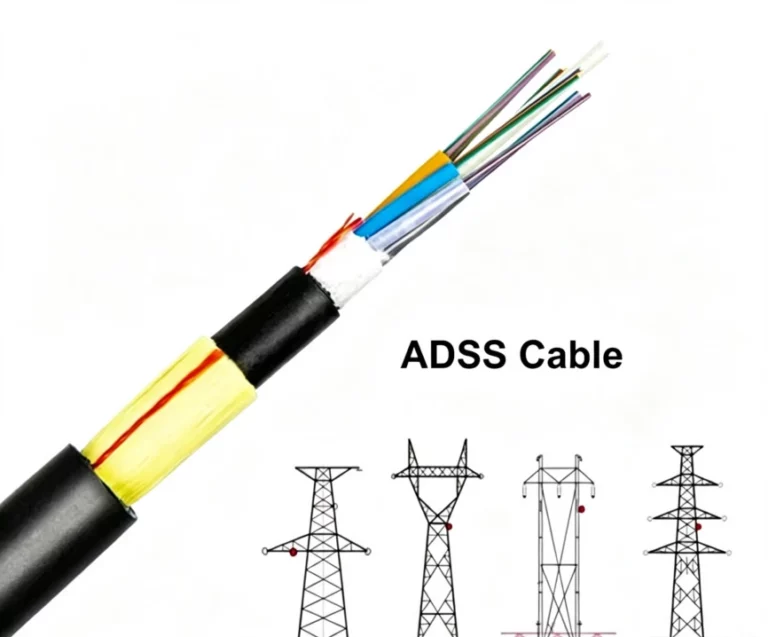
ADSS cables are entirely dielectric and do not contain any metal support, making them possible to be mounted directly onto power lines.
- Single Sheath ADSS Cable: This is lightweight and easy to install, thus suitable for short distances or lower loads.
- Double Sheath ADSS Cable: This provides mechanical strength and weatherproof qualities, thus best suited for high voltage lines.
ASU Cable (Armored Single-Use Cable)
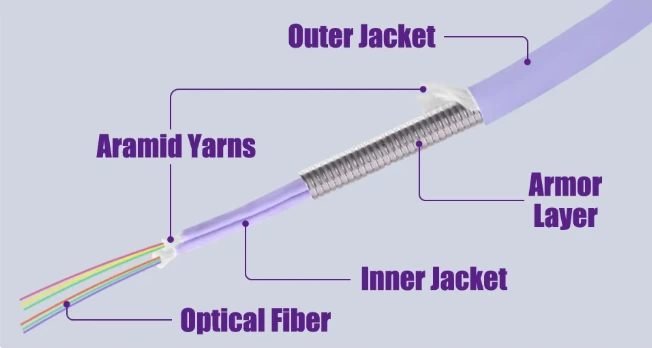
ASU cables are armored types of optical fibers that are used in areas of high mechanical stress, such as underground conduits and other industrial or even building environments, where there are chances of high pressure or animal bites.
Indoor & Outdoor Cable
Indoor & outdoor cables combine the flexibility of indoor types with the durability of outdoor types. They allow seamless deployment from inside buildings to external routes, reducing the need for multiple cable types and simplifying network installation.
Indoor Cable
These cables are flexible and can easily be bent. These cables can easily be passed through ceiling spaces or conduits.
- Indoor Armored Cable: Cables with an extra armor feature for added protection in rugged environments.
- Standard Indoor Cable: Best suited for residential or commercial offices.
AirBlow Cable
The AirBlow cable is specifically designed to be deployed inside ducts by means of compressed air. Such an optical fiber is perfect for installation in metro networks or any other large-scale project where fast fiber installation is required.
Hybrid Cable
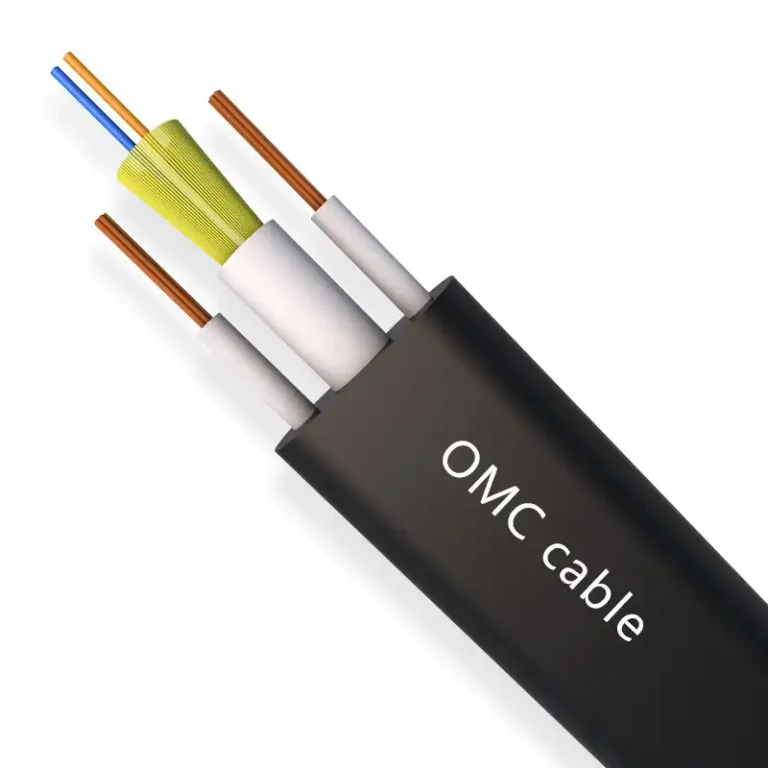
The hybrid cable combines optical fibers with copper wires or power lines. Hybrid optical fibers are capable of transferring both information and power, which makes them suitable for surveillance networks and smart buildings.
Specialty Fibers
Includes polarization-maintaining fibers, photonic crystal fibers, and other advanced types used in sensors, medical instruments, or industrial applications.
How to Choose Types of Optical Fibers
Choosing the types of optical fibers requires taking into account several considerations:
|
Selection Criteria |
Recommended Cable / Fiber Type |
|
Long-Distance Transmission |
Single-Mode Fiber (SMF), Outdoor/ADSS Cables |
|
Short-Range & High-Density LANs |
Multi-Mode Fiber (MMF), Indoor Standard Cables |
| Direct Power + Data Delivery |
Hybrid (Opto-Electronic) Cables |
| High-Voltage Power Line Corridors |
ADSS Cables (Single or Double Sheath) |
| Underground Conduits / Pest Risks |
ASU Cables, Indoor Armored Cables |
|
Rapid Urban / Metro Expansion |
Air-Blown Microcables |
| Seamless Exterior-to-Interior Routing |
Indoor & Outdoor Combined Cables |
Conclusion
Understanding the distinctions between optical fiber mediums and protective cable structures is vital to constructing an efficient communication network. By aligning your choice with the installation environment, distance requirements, and physical stress risks, you ensure a high-speed connection that remains stable for decades