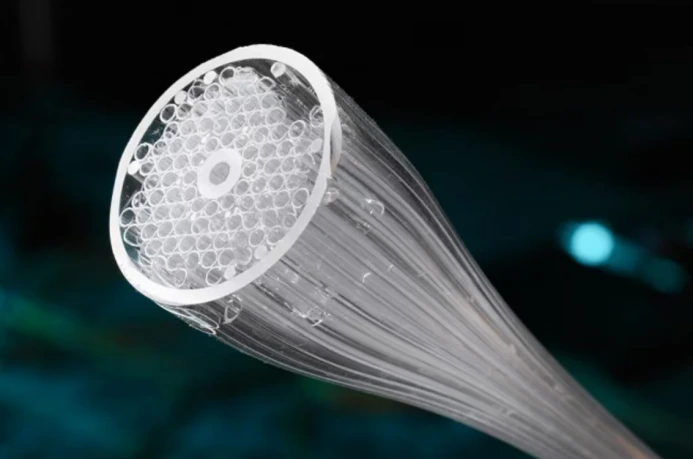








In fiber optics, it is essential to ensure the growth of data flow along with being expandable. The traditional way to install fiber includes pulling it through ducts, which may be a laborious and delicate process in case of long and complicated routes. An Air Blown Fiber Cable uses a different installation method. Instead of relying mainly on pulling force, the cable is installed through a microduct by a combination of compressed air and mechanical pushing.
It may help simplify fiber deployment in telecommunications, data centers, campus networks, and other infrastructure projects. Since this cable is lightweight and suitable for installation within small ducts, it can offer more flexibility in terms of growing network capacity. Knowing its structure and the principle of installation, one can better understand the essence of air-blown fiber technology implementation in network building.
1. What Is Air Blown Fiber Cable?
Definition and Basic Structure
An Air Blown Fiber Cable is a compact optical fiber cable designed to be installed into a microduct using compressed air. The cable contains optical fibers that transmit data through light signals, together with protective elements that provide mechanical stability during installation and operation.
Cable diameter and weight are much lighter compared with traditional fiber cables. In accordance with the number of fibers in the cable, there may be 2, 4, 12, 24, or more fibers in an air-blown cable. The outer jacket of the cable is usually made of a polymer material and has a smooth surface to make the cable movement easier within the microduct. Its basic structure may include:
- Optical fibers for data transmission
- Fiber coating and protective layers
- Strength members for mechanical support
- A low-friction outer jacket
- A compact construction suitable for microduct installation
The exact structure varies according to fiber count, installation distance, environmental requirements, and manufacturer specifications.
.webp)
Figure 1. Structure of an air blown fiber cable: optical fibers, coating and protective layers, strength members, and a low-friction outer jacket
How Air Blown Fiber Cable Differs From Conventional Fiber Cable
The main difference is not the optical transmission principle but the installation method and physical design. A conventional fiber cable is commonly pulled through a larger conduit or placed directly in a designated pathway. An Air Blown Fiber Cable, by contrast, is engineered for air-assisted installation through a relatively small microduct.
This difference can affect deployment planning. Conventional cables may require more pulling equipment and greater attention to pulling tension, while air-blown installation uses compressed air to create a forward force around the cable. The smaller cable format can also leave additional space in a duct system for future network expansion.
-scaled.webp)
Figure 2. Conventional pulling vs. air-blown installation
2. How Does Air Blown Fiber Cable Work?
How Microducts Guide Air Blown Fiber Cable
A microduct provides the controlled pathway through which the cable travels. These ducts are usually installed in advance and can be placed underground, inside buildings, or along other network routes. Their internal diameter must be compatible with the cable and installation equipment.
For instance, a microduct with an internal diameter of around 10–16 mm may be used for certain compact fiber cables, although the appropriate dimensions depend on the cable diameter and installation system. The duct should also have a smooth internal surface and suitable bends because excessive friction can reduce installation efficiency.
How Compressed Air Propels the Fiber Cable
During installation, compressed air is introduced into the microduct while the cable is fed into the duct by a blowing machine. The airflow travels along the cable and generates aerodynamic drag on its outer surface. At the same time, the installation machine provides controlled mechanical assistance.
The combined forces allow the Air Blown Fiber Cable to move through the microduct without depending entirely on conventional pulling. Installation parameters such as air pressure, airflow rate, cable speed, duct condition, and route length need to be controlled carefully. Depending on the equipment and cable design, installation speeds can reach several tens of meters per minute.
-scaled.webp)
Figure 3. Compressed air and mechanical feed propel the cable through the microduct
How the Cable Moves Through the Duct
Cable movement depends on the relationship between the cable surface, airflow, duct geometry, and mechanical feed. Overbending or poor alignment of the duct may cause higher friction and a shorter installation distance. Before installing the cable, there is usually an inspection of the microduct for any obstruction, moisture, bending, or other issues that might impact the movement of the cable. This will help ensure uniform cable installation.
3. What Are the Main Features of Air Blown Fiber Cable?
Lightweight and Compact Cable Design
One major characteristic of an Air Blown Fiber Cable is its compact construction. A smaller cable can require less physical space and may be easier to handle during network deployment. Lower cable weight can also reduce the mechanical load placed on supporting infrastructure.
For telecom operators, network contractors, and fiber infrastructure projects that require compact cables with reliable blowing performance, OMC’s 4-48F Air Blow Optical Cable is a practical option. The cable is designed with 4–48 fibers and a low-friction outer sheath with special grooves to support efficient air-blown installation through microducts.
- Fiber count:4–48 fibers
- Cable diameter:8–4.5 mm
- Cable weight: approximately 8–17 kg/km
- Fiber type: ITU-T G.657A2 available
- Sheath: LSZH or HDPE
- Bending radius:15D static and 25D dynamic
- Operating temperature:-40°C to +70°C
.webp)
Figure 4. OMC 4-48F Air Blow Optical Cable and key specifications
Flexible Fiber Deployment and Expansion
Air-blown technology can support phased network construction. Instead of installing all required fibers at the beginning, infrastructure operators can prepare microduct pathways and deploy additional fiber cables when demand increases.
This approach is useful when future traffic growth is difficult to predict. A network may initially require only a small number of fibers, while additional cables can be installed later through available microducts. As a result, construction can be divided into different stages instead of completing the entire fiber capacity in one installation.
-scaled.webp)
Figure 5. Phased fiber deployment and future expansion through microducts
Reduced Physical Installation Requirements
Using compressed air technology to install the cable through the microduct, an Air Blown Fiber Cable is capable of eliminating some of the physical needs of conventional cabling. Long-distance paths are most suited for this type of cable installation if the duct system has been well planned.
Special equipment used in this installation includes an air compressor, fiber blowing equipment, cable guide, and other duct accessories. It is also important to regulate the speed and pressure during the installation to remain within the physical limitations of the cable.
Protection and Long-Term Network Performance
Despite the lightweight nature of air-blown cables, enough protection should be provided against mechanical and environmental stresses. The outer jacket, strength member, fiber coating, and microduct collectively provide protection to the optical fibers.
In the case of outdoor applications, various elements such as temperature, moisture, UV radiation, crushing, and bending should be considered. For indoor applications, fire performance and installation conditions may also be important. When the cable, microduct, and installation method are properly matched, an Air Blown Fiber Cable can support stable optical transmission over long-term network operation.
4. Conclusion
Air Blown Fiber Cable is a small-scale fiber cable that can be installed in the microduct using compressed air and mechanical pulling. The lightweight, easy deployment process, and ability to extend in phases make the cable useful in telecommunications, data centers, and other densely packed fiber systems.
It is important to know that the success of the installation does not depend only on the cable itself. Microduct quality, route design, pressure, airflow, cable specifications, and protection are among other factors that affect the result of the deployment. Using the right system configuration and installation practices, air blown fiber can be an efficient solution for creating a scalable communication network. Should you have any questions regarding Air Blown Fiber Cable or fiber optic deployment, feel free to contact OMC.
-768x576.webp)
-768x290.webp)