








When a remote device has to be both connected to the network and powered, it becomes necessary to use separate cables for this purpose, which complicates the process of cable routing and takes up more space during cable installation. This is especially true for applications like surveillance cameras, wireless systems, industrial equipment, and telecommunication facilities that require not only data transmission but also electrical power supply over one route.
A Hybrid Fiber Optic Cable addresses this requirement by combining communication and power transmission in one cable structure. This design can simplify cable deployment while supporting high-bandwidth optical communication and electrical power delivery. The following sections explain how this cable works and the main benefits it can provide for different network applications.
What Is a Hybrid Fiber Optic Cable?
A Hybrid Fiber Optic Cable integrates optical fibers for data transmission and copper conductors for power delivery within one cable assembly. The two transmission media remain physically separated but share the same outer structure. This design is useful for remote devices that require both communication and power, reducing the need to install separate fiber and power cables.
How Does a Hybrid Fiber Optic Cable Combine Fiber and Power?
Optical fibers carry information by means of light while copper conductors supply the connected devices with electricity. Thus, for example, a network camera may receive data via optical fibers while being powered via copper conductors. Fiber selection depends on factors such as fiber type and count, while copper sizing depends on voltage, current, conductor gauge, and allowable voltage drop.
How Does Its Structure Support Data and Power Transmission?
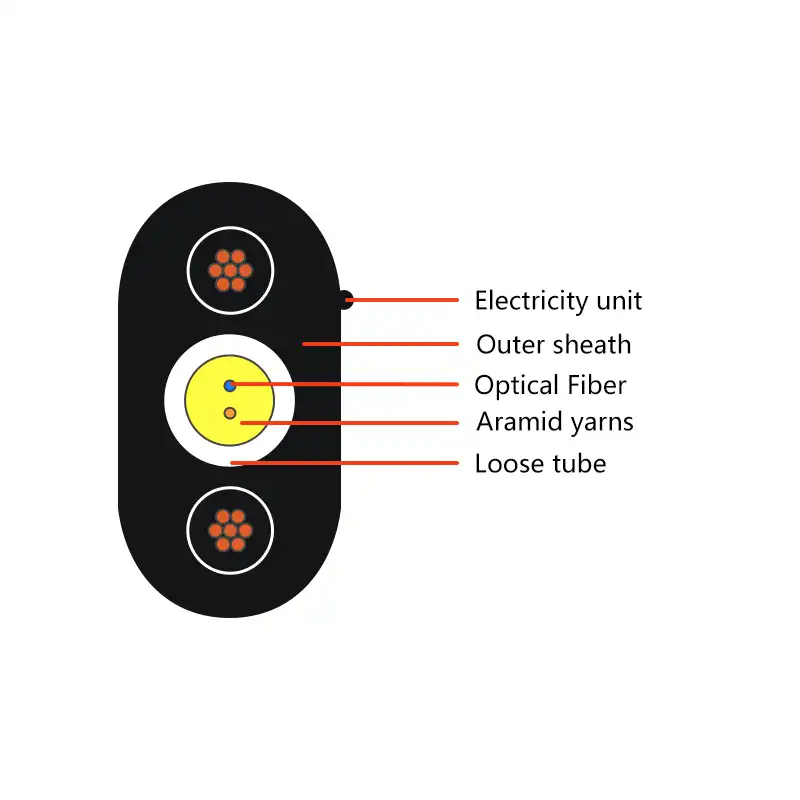
Hybrid Fiber Optic Cable consists of optical fibers and copper conductors which are protected by insulating materials, strength elements, fillers, and an outer sheath. Hybrid Fiber Optic Cables of different types are intended for use in indoor conditions, outdoors, and industrial environments. The mechanical construction of the cable protects against bending, tensioning, compression, moisture, and temperature changes.
What Are the Main Benefits of a Hybrid Fiber Optic Cable?
A Hybrid Fiber Optic Cable will have multiple benefits when there is a need for high-speed transmission of data and power to a device. Such advantages are especially useful when a distributed system is in use with nodes that could be installed tens or even hundreds of meters away from the network and power infrastructure.
1. Support High-Speed Data Transmission
A large amount of communication data is transmitted through optical fibers because they can carry high data volumes with low transmission loss and strong resistance to electromagnetic interference. Therefore, a Hybrid Fiber Optic Cable can be suitable for applications that require high-resolution video, industrial data, telecommunications, and other bandwidth-intensive information.
The actual transmission performance depends on factors such as fiber type, fiber count, network equipment, and transmission standards. With suitable optical components and network equipment, fiber-based systems can support data rates of 100G and beyond. However, the cable itself does not determine the overall network speed, as additional equipment and compatible network infrastructure are required to achieve the intended performance.
2. Enable Simultaneous Power and Data Transmission
It is one of the major benefits in that it is possible to use the same cable for both electrical power and optical communication. It can be very beneficial in the case of equipment like remote cameras, wireless communication devices, industrial sensors, and access devices, which would need to be constantly connected without the presence of an electrical outlet.
The power carrying capacity should be chosen based on the load connected. The system, which uses 24 V with 2 A current, requires a 48 W power supply at the end point. So, taking into account losses in the transmission, the size of the copper conductor and cable length should be estimated in order not to exceed the maximum voltage, which is applicable for the equipment.
3. Reduce Cable Quantity and Installation Space
The use of two cables in one installation will result in an increase in the number of cables to be installed, particularly when several remote devices need to be linked through a building. A combined design can help simplify the physical infrastructure while still providing both communication and power.
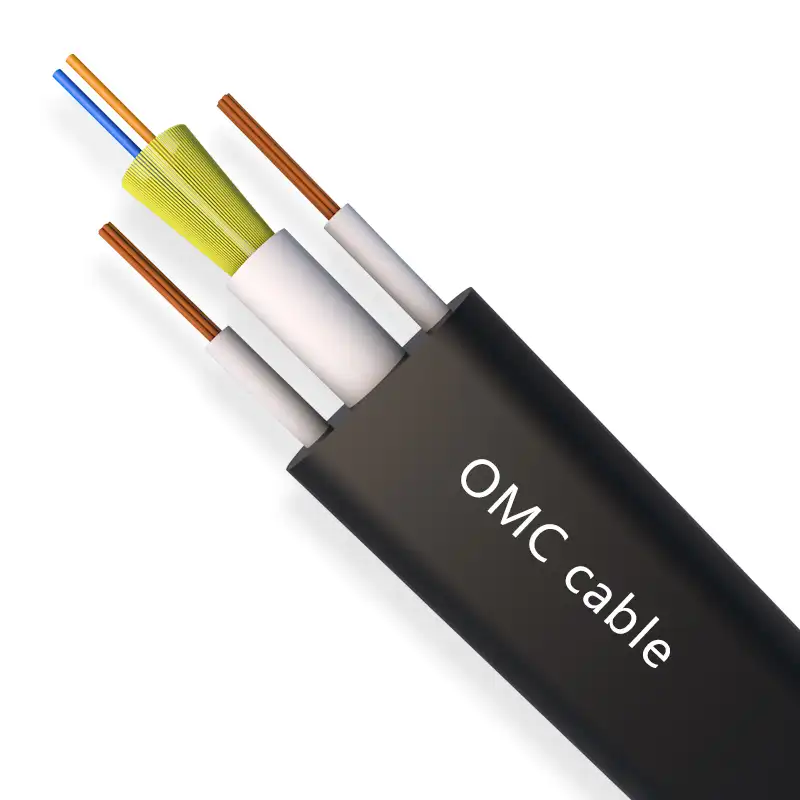
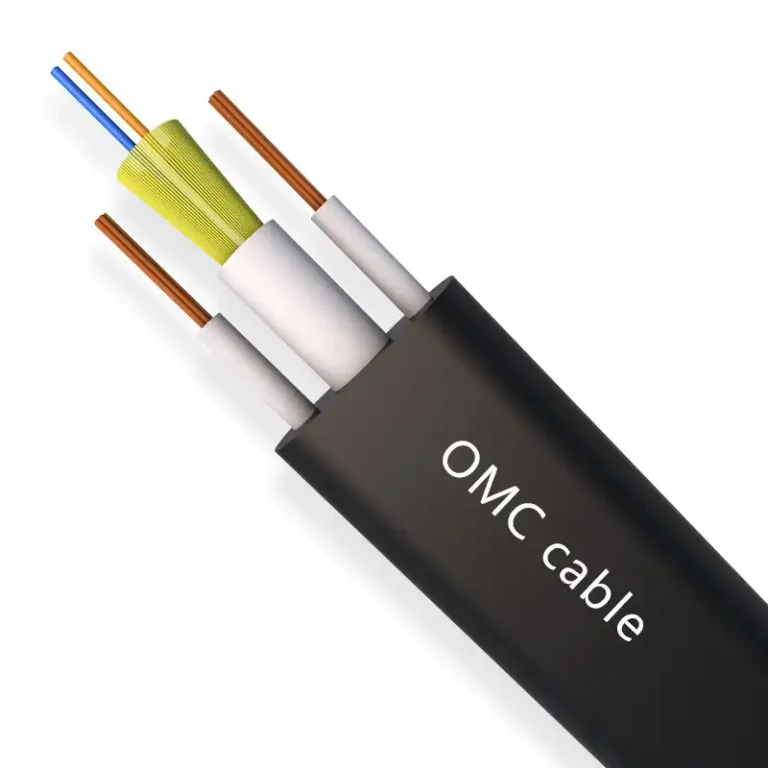
For projects seeking to simplify cable routing and reduce separate cable runs, OMC’s Hybrid 2 Fibers&1.5mm×2 Cable is a suitable choice. It combines two G657A2 optical fibers and two 1.5 mm² power conductors in one cable, allowing data transmission and power delivery to share the same cable route. The cable also uses an LSZH jacket and has a compact flat structure, making it suitable for installations where cable organization and space efficiency are important.
4. Support Long-Distance Connectivity
Optical fiber is very suitable for transmission of data over long distances due to its relatively low attenuation as compared to copper communication cables. As a result, data can easily be transmitted over large distances without signal regeneration along the route.
The limitation is that power transmission behaves differently. Copper power conductors experience voltage drop as distance and current increase. Therefore, a Hybrid Fiber Optic Cable can support long-distance data transmission, while the practical power distance may be shorter and must be calculated from conductor resistance, current, voltage, and allowable voltage drop.
For this reason, hybrid cable design should consider both transmission paths rather than treating the fiber distance as the only design limit.
5. Improve Network Reliability and Signal Quality
Communication through fiber is immune to Electromagnetic Interference (EMI), unlike data conductors which may be made of metal. This may be of great importance in cases where there are motors, variable-frequency drives, generators, or other sources of electrical noise. A Hybrid Fiber Optic Cable will thus offer a means of communication with a high immunity to EMI while at the same time providing power through copper conductors.
Conclusion
The Hybrid Fiber Optic Cable is a combination of optical data transfer and electrical power transmission in a single cable construction, which makes it ideal for remote cameras, telecommunications, industrial automation, and many other devices needing connectivity as well as power. The major advantages of the Hybrid Fiber Optic Cable include fast data transfer, dual transfer of power and data, reduction in cabling, optical transfer over long distances, and immunity to Electromagnetic Interference (EMI).
The best design for your needs will depend on various factors, including fiber type, number of fibers, conductor sizes, power needs, cable lengths, installation sites, and connector designs. If you have any queries or need help with selecting a cable, contact OMC now!
-768x576.webp)