




In direct burial applications, duct applications, and harsh industrial settings, ordinary fiber optic cables often break down from mechanical stress, water damage, or animal attacks. The armored fiber optic cable is what you need in order to sustain constant data flow in these extreme conditions. It will take knowledge of cable types and of the stressors involved in order to choose the correct one. Here is the information you need to know to make the right choice.
1. Understanding the Main Types of Armoured Fibre Optic Cables
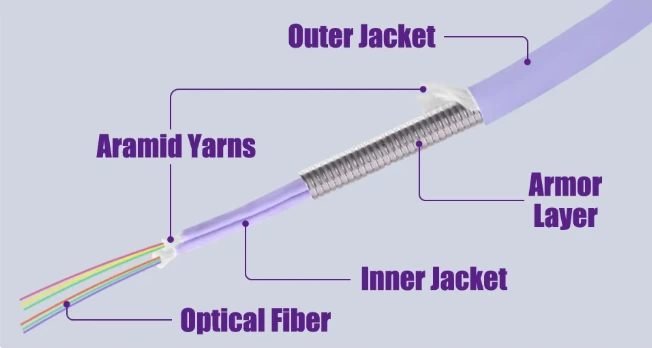
The major purpose of an armoured fibre optic cable is to protect the delicate glass optical fibres from external influences by means of a protective internal metal or dielectric barrier. According to their structure and physical properties, the following types of armoured fibre optic cables can be distinguished:
Steel Tape Armoured (STA) Cable
It is made with a corrugated steel tape (CST) applied longitudinally along the core. STA provides a great resistance to crushing (1500 N/100mm – 3000 N/100mm) and protection from rodents. Thus, it is perfect for being laid underground and buried.
Steel Wire Armoured (SWA) Cable
Made of one or two layers of helically applied galvanized steel wires. Such a design provides outstanding tensile strength (the tensile rating ranges from 3000 N up to 10,000 N or more). It is great for installing in vertical shafts, aerial installations, and underwater.
Aluminium Interlocked Armour (AIA) Cable
It consists of interlocked aluminium tape wound around the core. AIA is 30% – 40% lighter than steel variants and is very flexible. (dynamic bend radius as low as 20 times the cable diameter).
To simplify your selection process, the table below highlights the key physical metrics for each armoured fibre optic cable variant:
| Armour Type | Primary Structural Material | Crush Resistance (N/100mm) | Tensile Performance (N) | Typical Deployment |
| Steel Tape (STA) | Corrugated Coated Steel Tape | 1500 – 3000 | 1000 – 3000 | Underground Ducts, Direct Burial |
| Steel Wire (SWA) | Galvanized Carbon Steel Wires | 2000 – 5000+ | 3000 – 10000+ | Vertical Shafts, Aerial, Submarine |
| Aluminium Interlocking Armour (AIA) | Interlocking Aluminium Tape | 1000 – 2000 | 800 – 1500 | Indoor Industrial Installations, Open Cable Tray Systems |
2. Key Selection Factors for Armoured Fibre Optic Cable
To select the right armoured fibre optic cable, one has to consider four main engineering specifications:
Environment & Burial
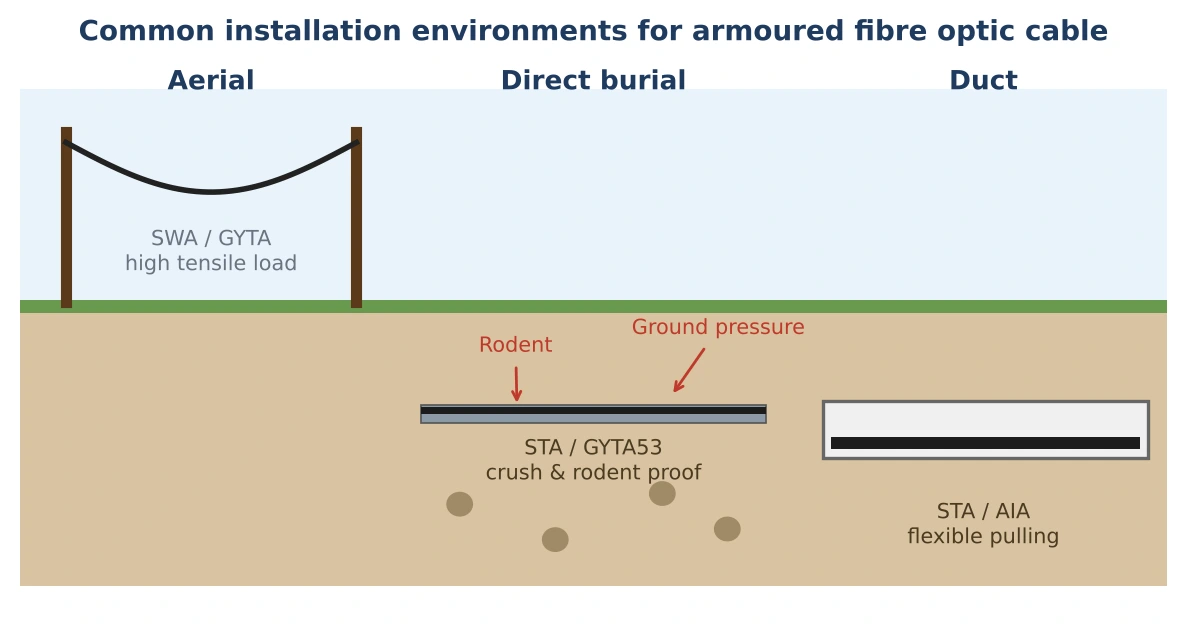
The method of burial determines the actual mechanical stresses that the cable will experience during use. Cables that are directly buried have to be equipped with armour that has a high capacity and can withstand moisture, either through water-swellable tape or gel coating. Aerial cables have to be tough enough to stand up to tensile pressures due to the wind blowing and snow falling. For cables in ducts, the ratio of outer diameters should be balanced with a friction coefficient below 0.2 to ensure smooth pulling.
Mechanical Resistance – Rodents & Crush
One of the biggest problems of outside cables is rodent bites. Tough armoured fibre optic cables create impenetrable metallic protection against rodents. If your installation is located in areas with high loads due to traffic or mechanical load in general, ensure that crush ratings in the short-term period are 3000 N/100mm and 1000 N/100mm for long-term use.
Number of Fibres & Modes
- Fiber Mode: The OS2 single-mode fiber is suitable for long-distance links above 10 km, where the attenuation rate should not be more than 0.35 dB/km at 1310nm and 0.22 dB/km at 1550nm. The indoor or campus backbone ranging from 100m to 500m can adopt OM3 or OM4 multimode fiber.
- Fiber Count: The typical fiber count will be from 4 to 144 fibers. To allow expansion of the network without replacing the cable, a 20%-30% extra fiber buffer is recommended.
Outer Jacket Material
The outer jacket material is in direct contact with the outside environment; therefore, select the material according to the installation area:
- Polyethylene (PE): Highly resistant to ultraviolet light, water, and abrasions. This is the conventional jacket material for outdoor direct-buried and duct armor fiber optic cable installation.
- Low Smoke Zero Halogen (LSZH): Produces a small amount of halogen gases and low smoke while burning to satisfy the fire retardancy standards of IEC 60332.
3. How to Choose Armoured Fibre Optic Cable Based on Different Scenarios
Matching your armoured fibre optic cable choice to specific field conditions ensures long-term system reliability without over-engineering your installation.
Underground Direct Burial and Long-Distance Trunks
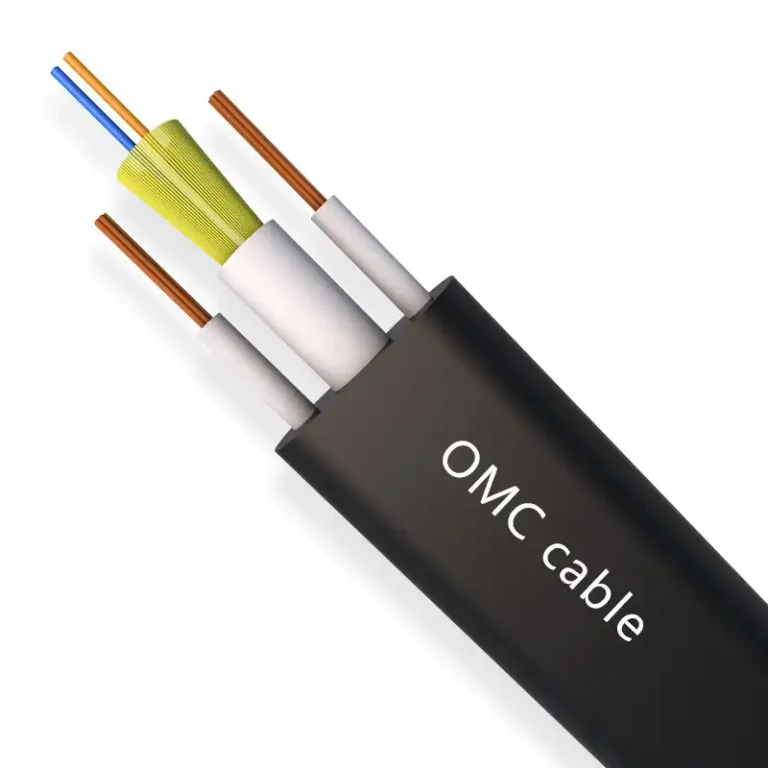
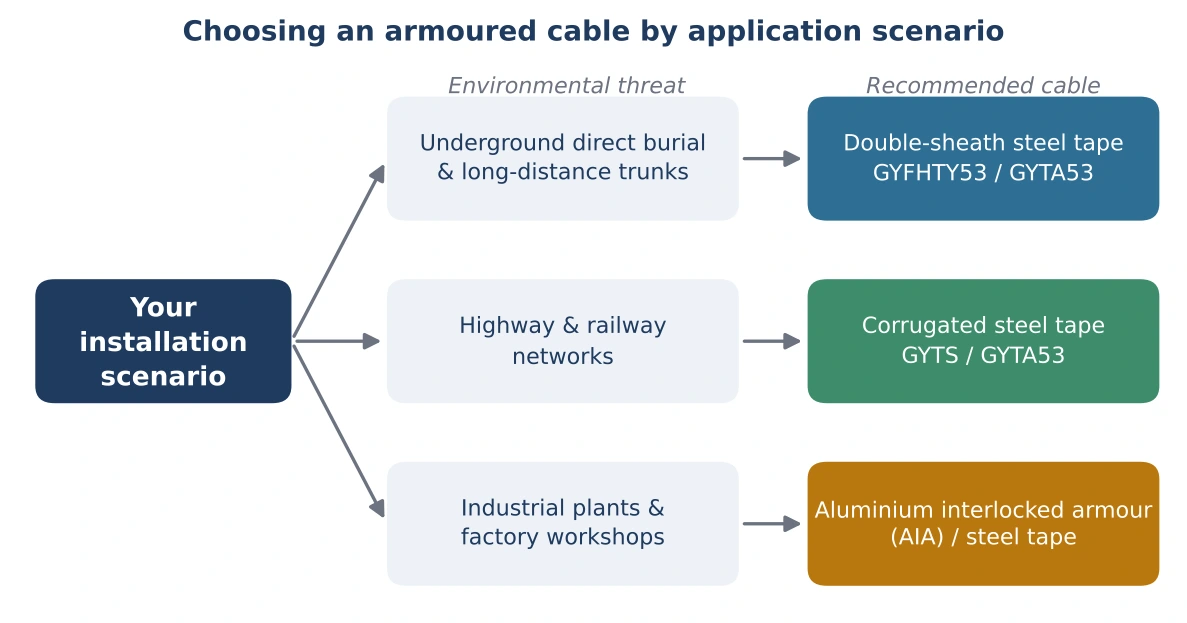
This kind of cable needs to be highly resistant to harsh environmental conditions, including ground pressure, moisture, and rodent attacks. For heavy-duty underground backbones, it is recommended to use durable double-sheath cables such as OMC CABLE-144F Armoured Cable GYFHTY53. This cable type features a non-metallic central strength member (FRP), stranded loose tubes, steel tape armour, and a dual PE jacket, and provides lightning-proof design, 3000 N crush resistance, and moisture protection.
Highway and Railway Transportation Networks
They operate in an unstable environment with continuously changing topography, and switching from aerial to underground cabling within the duct is
needed. Medium-weight cables with corrugated steel tape armour (GYTS and GYTA53 types) offer a good compromise between tensile strength and flexibility required to cope with constant thermal movements and vibrations.
Industrial Plants and Factory Workshops
In factory buildings, cables suffer from machine vibrations, oil spills, and narrow bends. To solve this problem in indoor industrial cabling, lightweight aluminium interlocked armour (AIA) and single-jacket steel tapes are used. Their small bending radius helps to rapidly lay cables along the shortest possible route.
4. Conclusion
Selecting the best armoured optical fiber cable comes from considering numerous factors such as environment, physical protection, optical properties, and budget. In light of your laying techniques, environmental threats, and expected bandwidth increases, it becomes possible for you to construct an optical network that is likely to last for decades without any trouble.
OMC CABLE is an international producer of high-quality optical communication cables. If you need technical information about customized fiber counts and choosing armoured fiber optic cables, you are most welcome to contact us.