







Taking into account the rapid growth of fiber optics in 5G, data centers, and FTTH access networks, fiber optic testing seems to be a vital stage in ensuring the smooth operation and performance of fiber optics. Among the testing equipment available, OTDR vs OLTS remain two common choices in engineering practice. Although both tools are used in fiber optics measurements, their working principles and applications vary greatly. Learning about OTDR vs OLTS will help professionals to select the proper tool in order to increase both productivity and effectiveness of their work.
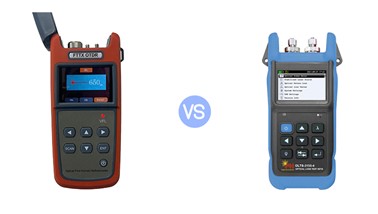
1.What Is OTDR?
The Optical Time Domain Reflectometer (OTDR) is a diagnostic instrument that helps identify the condition of fiber optic cable. This testing technique involves sending light pulses down through the fiber optic cable and evaluating the returned pulses. This allows OTDR to create the fiber optic trace where all events in the cable are recorded, including splicing, connection, bending, and breakage.
OTDR is widely used in:
- Long-distance backbone fiber networks (10–120 km)
- FTTH and FTTB distribution networks
- Metro and regional fiber maintenance systems
2.How Does OTDR Testing Work?
The operation of OTDR is based on Rayleigh and Fresnel reflections.
During operation:
- A short optical pulse is transmitted into the fiber
- Rayleigh scattering occurs continuously along the fiber core
- Fresnel reflections occur at points such as connectors, splices, bends, or breaks
- The equipment measures the distance through the time difference
Key technical parameters:
- Wavelengths: 1310nm / 1550nm / 1625nm (used for live fiber monitoring in some cases)
- Pulse width: 5ns–10μs (adjustable depending on resolution and distance)
- Measurement capability: up to 120km+ fiber links
- Spatial resolution: 0.5m–1m
- Event loss detection sensitivity: 0.01–0.1dB
3.Advantages of OTDR
OTDR offers several important advantages in fiber network testing:
- Single-ended testing: Only one side of the fiber is required for measurement
- Strong fault localization: Accurately identifies breaks, bends, and splice issues
- Graphical output: Provides a clear trace of the entire fiber link
- Long-distance capability: Suitable for networks ranging from 10km to 120km+
- Event-level analysis: Detects small changes in loss along the fiber path
4.What Is OLTS?
An Optical Loss Test Set (OLTS) is a fiber optic testing system composed of a stable light source and a power meter. It is designed to measure the total insertion loss of a fiber link and is mainly used for certification, acceptance testing, and standardized network validation.
OLTS is commonly applied in:
- Fiber optic installation acceptance testing
- Data center structured cabling verification
- Enterprise network performance validation
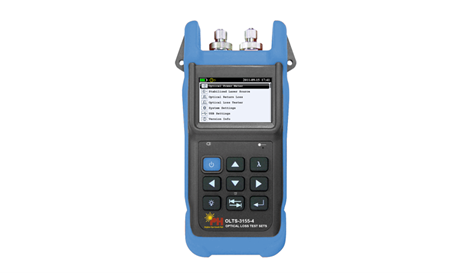
5.How Does OLTS Testing Work?
OLTS operates based on the optical power comparison method.
Testing process:
- A calibrated light source transmits a stable optical signal into the fiber
- The signal travels through the entire fiber link
- The system calculates insertion loss by comparing transmitted and received power
Unlike OTDR, OLTS does not analyze individual events. Instead, it focuses on verifying the overall transmission performance of the fiber link, making it ideal for standardized certification processes.
Key technical characteristics:
- Measurement accuracy: ±0.15–0.25dB
- Dynamic range: 0–80dB
- Testing method: requires dual-ended access
6.Advantages of OLTS
OLTS is widely used in fiber certification due to its reliability and precision:
- High measurement accuracy: Typically ±0.2dB
- Standards compliance: Meets TIA/ISO/IEC certification requirements
- Stable results: Less affected by reflections or backscatter noise
- Fast certification process: Suitable for large-scale deployments
- Clear pass/fail output: Direct numerical loss values for evaluation
7.OTDR vs OLTS: Key Differences
| Feature | OTDR | OLTS |
| Principle of measurement | Rayleigh backscattering and Fresnel reflection | Optical power difference |
| Testing Method | Single-ended testing | Dual-ended testing |
| Output Format | Distance-based event trace | Total insertion loss value (dB) |
| Accuracy Type | Event location accuracy ±1–5m | Loss accuracy ±0.15–0.25dB |
| Wavelengths | 1310/1550/1625nm | 850/1300/1310/1550nm |
| Dynamic Range | 25–50dB | 0–80dB |
| Measurement Distance | 1–120km+ | Typically ≤80km |
| Application Stage | Troubleshooting & maintenance | Installation & certification |
| Testing Focus | Individual events and faults | Overall link performance |
| Detection Capability | Splice, bend, and break location | Total link insertion loss only |
8.How to Choose Between OTDR vs OLTS
The selection between OTDR vs OLTS depends on the testing purpose and network stage:
- For fault troubleshooting: OTDR is the preferred tool
It helps locate breaks, bends, and abnormal splice losses in long-distance networks - For installation acceptance and certification: OLTS is required
It verifies whether the total link loss meets industry standards - For full network lifecycle management: Both tools should be used together
OTDR diagnoses faults, whereas OLTS verifies the total performance
In simple terms:
- OTDR = diagnostic and localization tool
- OLTS = certification and validation tool
9.Conclusion
The comparison of OTDR vs OLTS clearly shows that these two fiber optic testing instruments serve different but complementary purposes. OTDR is designed for precise fault detection and event analysis, whereas OLTS guarantees accurate measurements of end-to-end insertion loss and is used for certification purposes.
In actual operations, when handling fiber optic systems, using both OTDR and OLTS together helps boost efficiency and adherence to international standards.
For professional fiber optic testing equipment and reliable technical support, you can explore OMC.
If you have any questions about OTDR vs OLTS, or fiber testing solutions, feel free to contact us anytime.