







In parallel with the development of fiber optic networks in various industries, cable reliability is becoming no less significant than the speed of transmission. Outdoor, industrial, or crowded communication environments may cause fiber cables to suffer problems related to impact, moisture, temperature changes, or installation stresses. Armored Fiber cables are equipped with additional protective structures and offer reliable optical performance.
-800x363.webp)
The Working Principle of Armored Fiber
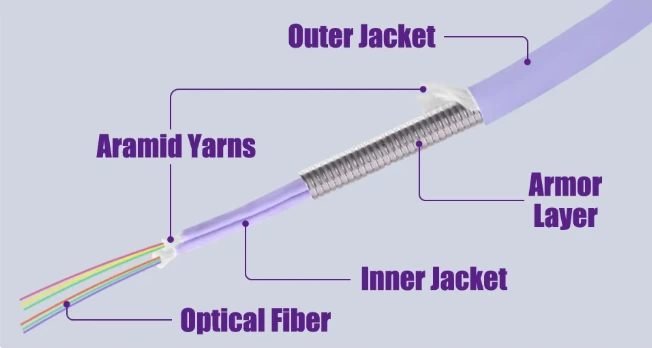
The working principle of Armored Fiber implies a multi-layered protection structure of the cable. On the one hand, optical fibers are responsible for the data transmission process. On the other hand, metal armor, strength members, and outer sheaths help protect them from external influence. When the cable is under certain tensions, pressures, bends, or impact, the layers of the cable help distribute and absorb applied force, reducing its impact on delicate glass fibers.
Various designs of armored cables may include different reinforcement strategies depending on the installation environment. For instance, the inclusion of steel tape increases the crush-resistance properties of the cable, the presence of strength members helps boost its tensile characteristics, and an additional protective jacket protects the cable from moisture or environmental damage.
What Are the Key Benefits of Armored Fiber Cables?
The advantages of armored fiber cables become especially valuable when cables are installed in environments where durability, stability, and long-term reliability are important. Compared with standard fiber cables, armored designs provide additional protection against physical stress and environmental challenges, helping reduce network interruptions and maintenance requirements.
-800x261.webp)
1. Protection from Physical Stress
One of the major benefits of using armored cables lies in their high resistance to mechanical stress. In the process of installation and functioning, fiber cables might face such stresses as pulling forces, crushing, bending, or accidental impact because of construction work and machinery near the cables. Being made of glass, optical fibers are sensitive to any external influences that might harm their functioning and cause additional repair work.
To provide better protection for internal fibers, armored cables use special strength members and protective layers. When you need higher protection from mechanical stress for your communication systems, OMC’s 12-48F Aerial Self-supporting Fig 8 Stranded Loose Tube Armored Cable GYTC8S provides extra security for aerial communication networks. It uses steel wire, a PE cushion layer, and corrugated steel tape as armor protection.
.webp)
2. Better Adaptation to Harsh Environments
When fiber optic cables are used for communication outside buildings and in industrial areas, they have to withstand changes in weather conditions and environmental factors, including moisture, temperature changes, dust, vibrations, and other external stresses. Without proper protection, all these environmental factors might deteriorate cable performance and increase the necessity of maintenance.
A reinforced cable structure allows the Armored Fiber to provide extra protection for communication and ensures more stable functioning of cables in harsh environments. If you plan to use your communication cables near roads, factories, or in underground paths, you should consider using additional armor that will be able to protect inner fibers from external impacts.
3. Lower Maintenance and Replacement Costs
Failure of fiber cables leads to unplanned expenditures, which include troubleshooting, fiber splicing, labor costs, and network downtime. While initially armored cables cost more than standard options, they can decrease the likelihood of cable damage and reduce maintenance needs. Organizations that depend on uninterrupted connectivity can also benefit from using a durable cable design since it leads to increased efficiency through lower repair costs and a longer service life for the cable.
4. Enhanced Resistance to External Threats
Cables that are used in outdoor and industrial installations might be exposed to some unexpected threats such as physical impact from other devices. For this reason, traditional fiber optic cables might need some additional protective elements for use in these conditions. Armored cables have an enhanced construction that serves as an extra shield from the external environment for optical fibers. As a result, these cables are a good option for places in which cables cannot be accessed after their installation, such as underground, outdoors,s and industrial networks.
5. Good Choice for High-Density Networks
Communication networks that operate today should ensure high capacity and high reliability while being manageable at the same time. Enterprises often have numerous fiber connections that are working continuously in compact environments. Armored Fiber cables ensure additional protection in high-density networks. Due to different constructions that include 12, 24, and 48 fiber variants, armored fiber cables can be used in different situations while ensuring the required additional protection. This feature allows organizations to plan for their future development while avoiding frequent cable changes.
Where Are Armored Fiber Cables Commonly Used?
The choice of application environment is one of the main criteria for choosing fiber optic cables. Armored designs are particularly convenient to use in those places where standard cable installations have increased risks.
Data Centers and Server Rooms
In data centers, there are many devices and equipment that are subject to constant maintenance and servicing. Strong cable designs can ensure reliable protection of the cable lines from accidents.
Industrial and Production Enterprises
There are many devices, machines, and communication systems in industrial enterprises. The strengthened structure will ensure stable connections under conditions of vibration, movement, and increased mechanical risk.
Installation in Open Areas and Underground
Outdoor cable installations have to withstand atmospheric conditions, changes in temperature, and installation pressure. Reinforced designs with waterproofing increase the resistance of cables.
Telecommunication Networks
Telecommunication networks are characterized by continuous operation over long distances. Cable protection allows reducing the risk of failures and ensures stable communication between network points.
-800x272.webp)
Conclusion
Armored Fiber cables offer some significant advantages for those networks that require enhanced protection, increased reliability, and durable performance. The strengthened structures make it possible to decrease the risks of cable injuries and provide stable optical transmission in difficult conditions. In all types of communications – from aerial to industrial and outdoor installations – the selection of proper cable design is critical to ensure reliable results. For any professional consultations regarding fiber cables, technical specifications, and other questions, you can contact OMC.