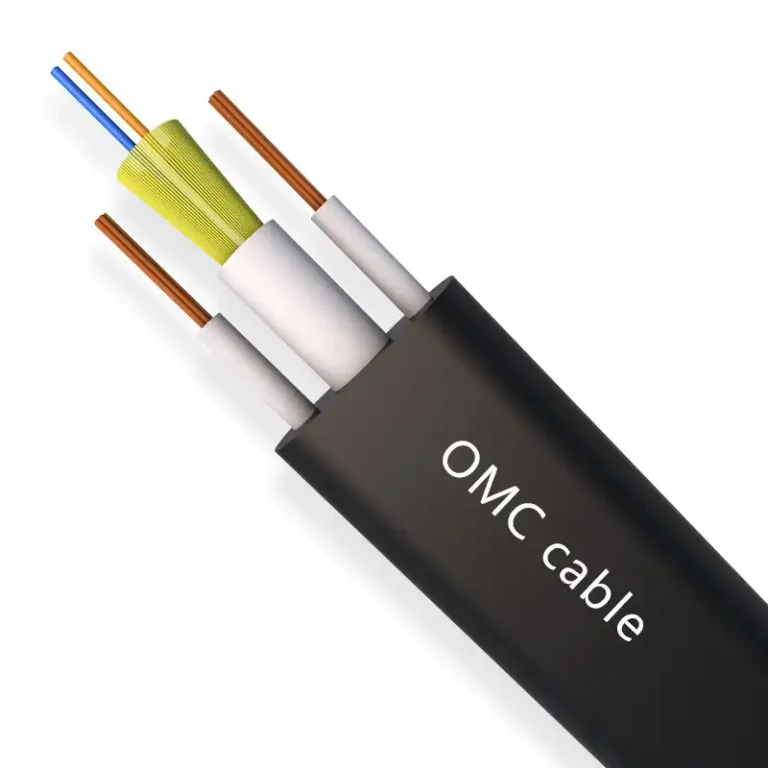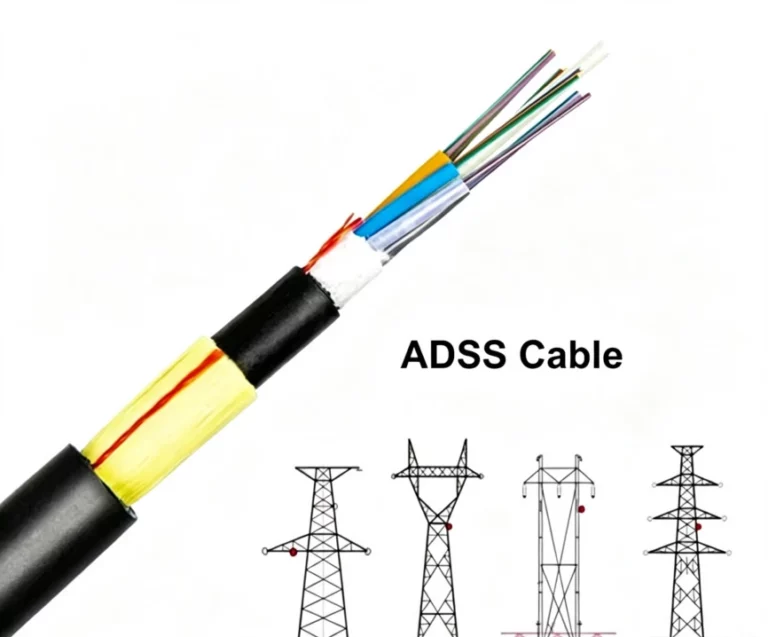








In telecommunications engineering, renewable energy monitoring, and smart construction applications, cables are typically exposed to harsh environmental factors such as UV radiation, moisture, temperature fluctuations, and mechanical impacts. Because optical fibers themselves are extremely fragile, even minor crushing forces can cause signal attenuation or physical fiber breakage. Among all available options, the Outdoor Armored Cable, specifically designed for fiber optics, is widely regarded as the most reliable choice for data and signal transmission due to its multilayer protective structure and superior environmental resistance.
1. Importance of the Outdoor Armored Cable in Communication and Network Engineering
1.1 Applications in Renewable Energy and Smart Grid Monitoring
Outdoor Armored Cables are extensively utilized for communication networks in solar power plants, wind farms, and high-voltage substations. Beyond transmitting control signals and monitoring data, the greatest advantage of this type of Outdoor Armored Cable is that it is completely immune to electromagnetic interference (EMI). This allows the network to maintain ultra-high-speed, zero-interference data transmission even when routed in parallel with high-voltage power lines or subjected to extreme temperature swings.
1.2 Applications in Industrial and Communication Infrastructure
These cables are widely deployed in long-haul backbone networks, Metropolitan Area Networks (MANs), Intelligent Transportation Systems (ITS), and remote telecom towers (such as 5G base station BBU-to-RRU fiber remoting). Deploying an Outdoor Armored Cable provides robust defense against rodent bites, bird pecking, and crushing mechanical forces, thereby drastically reducing network downtime and enhancing overall system reliability.
2. Structure and Materials of an Outdoor Armored Cable
2.1 Multilayer Design Principle
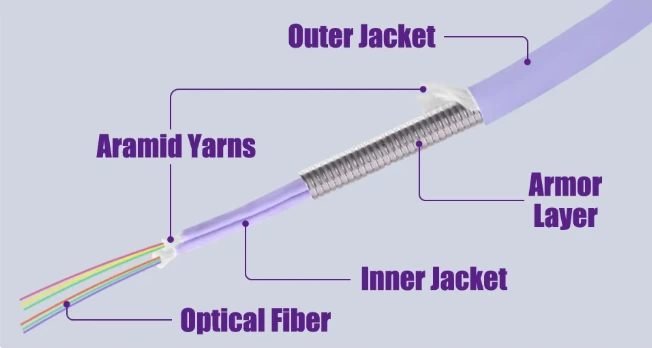
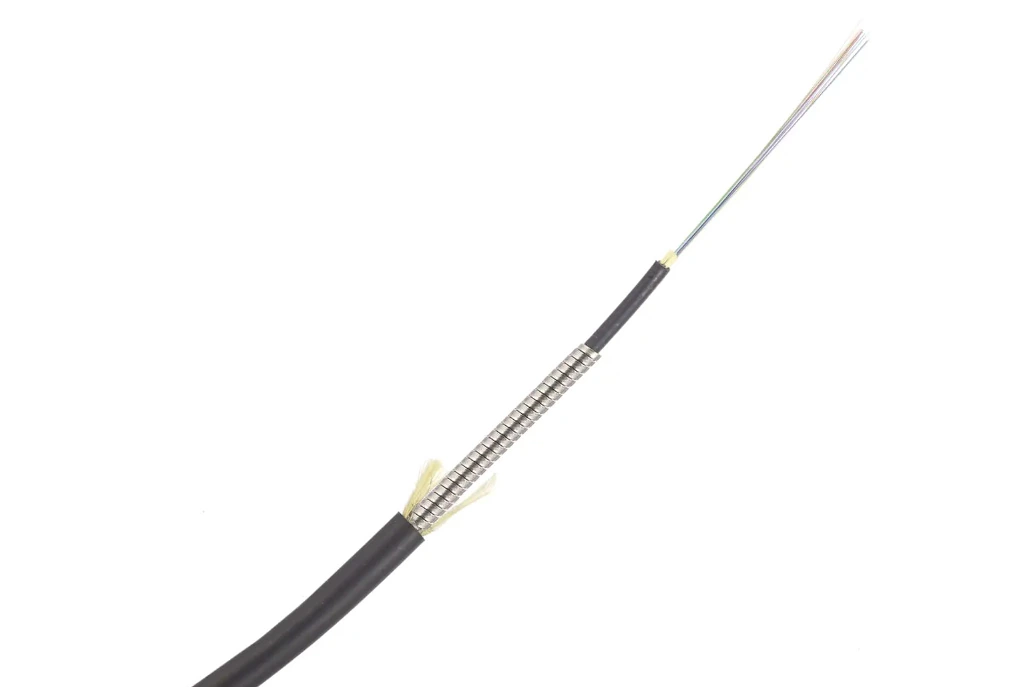
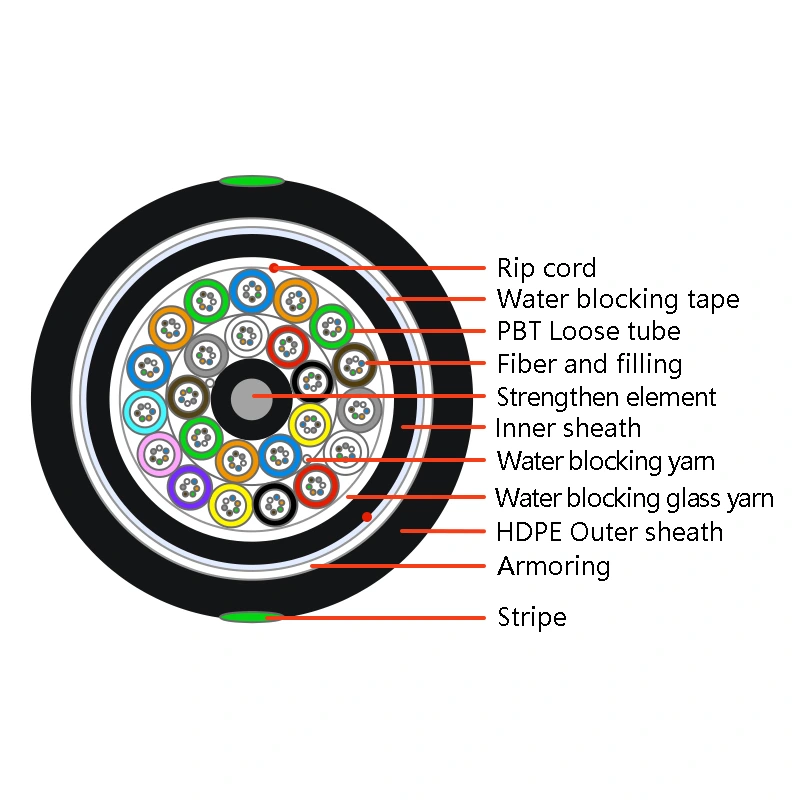
A high-quality Outdoor Armored Cable features a composite, multi-layered design that includes optical fibers, loose tubes (filled with gel), a central strength member, an armor layer, and an outer jacket. Each layer serves a specific physical or optical protective purpose.
Optical Fibers (Core): The core transmission medium of the Outdoor Armored Cable. Depending on the transmission distance, engineers select either Single-mode fiber (such as G.652D or G.657 bend-insensitive fiber for long-haul trunks) or Multi-mode fiber (OM3/OM4 for campus local area networks).
Loose Tube & Waterproofing: The optical fibers are housed within loose tubes made of high-modulus plastics and filled with a thixotropic waterproof gel. This gel blocks moisture ingress and cushions the fibers against external mechanical forces.
Central Strength Member (CSM): Located at the dead center of the Outdoor Armored Cable, the CSM is typically made of steel wire or non-metallic FRP (Fiber Reinforced Plastic) to absorb the primary tensile loads during installation.
2.2 Functions of the Armor Layer and Outer Jacket
Armor Layer (Steel Wires / Steel Tape): An Outdoor Armored Cable commonly uses a corrugated steel tape (PSP) longitudinal wrap or a helical single/double steel wire armor (SWA). This layer grants the cable exceptional crush resistance and forms an impenetrable steel barrier against termites and rodents.
Outer Jacket: The outermost line of defense for the Outdoor Armored Cable. It is usually extruded from High-Density Polyethylene (PE) or Low-Smoke Zero-Halogen (LSZH) compounds, providing outstanding resistance to UV aging, moisture, and extreme weather.
3. Performance and Environmental Suitability of the Outdoor Armored Cable
3.1 Key Engineering Performance Metrics
According to optical communication standards, a standard Outdoor Armored Cable is engineered to operate across a broad temperature range from -40°C to +70°C. They feature a long-term crush resistance ranging from 1,000 N/100mm to over 3,000 N/100mm, and rated tensile strengths between 1,500 N and 3,000 N. Their ingress protection and water-blocking capabilities fully comply with the requirements for prolonged dampness or direct water immersion.
3.2 Environmental Factors Affecting Cable Lifespan
Several environmental variables can compromise the lifespan of an Outdoor Armored Cable and its signal integrity:
Moisture ingress leading to “hydrogen aging” (hydrogen sickness) in fibers, which increases optical attenuation.
Extreme thermal cycling (freeze-thaw cycles) causes uneven expansion/contraction among different materials, triggering microbending losses.
Improper bending during installation that violates the minimum bend radius, causing macrobending light leakage.
Rodent and insect attacks are attempting to breach the inner core.
Technical Lifespan: With proper system design, standard installation practices, and regular splice-point maintenance, an Outdoor Armored Cable typically achieves a reliable operational lifespan of 20 to 30 years.
4. Selection Standards and Engineering Design Considerations
4.1 Selection Based on Transmission and Structural Requirements
In network design, selecting the right Outdoor Armored Cable depends on key parameters such as fiber type, core count (fiber count), and the method of installation.
Core Count: Common configurations for an Outdoor Armored Cable include 4, 8, 12, 24, or even high-density counts like 144 or 288 cores to accommodate different bandwidth aggregation requirements.
Fiber Selection: Single-mode (SM) fiber is mandatory for cross-campus or long-distance backhauls. For high data-rate applications under 300 meters, Multi-mode (MM) fiber can be chosen.
4.2 Selection Strategies for Different Environmental Conditions
| Installation Scenario | Recommended Outdoor Armored Cable Type | Core Benefit |
| Duct / Direct Burial | Corrugated Steel Tape Armored (e.g., GYTS / GYTA) | Steel tape offers excellent crush resistance and anti-rodent defense; it resists deformation during duct pulling. |
| Aerial / Overhead (High Tension) | Steel Wire Armored / Self-Supporting (e.g., GYTC8S) | Steel wire provides extreme tensile strength to withstand high wind loads and heavy ice accumulation. |
| High EMI / Lightning-Prone Areas | Non-Metallic Armor / FRP Strength Member (e.g., GYFTY) | Completely metal-free, non-conductive, and immune to lightning strikes and strong electromagnetic fields. |
5. Installation Guidelines and Maintenance Strategies for the Outdoor Armored Cable
5.1 Standard Installation Requirements
Burial Depth: For direct burial applications, the Outdoor Armored Cable should be buried at a depth of at least 0.7 meters (below the permafrost line) in hard soil, cushioned with sand, and covered with protective tiles or warning tape.
Bend Radius (Dynamic vs. Static): This is the most critical metric in fiber deployment. During installation (dynamic), the bend radius of the Outdoor Armored Cable must be at least 20 times the cable’s outer diameter. Once installed and fixed (static), it must maintain at least a 10 times multiplier. Dropping below these limits will cause severe macrobending attenuation or permanent fiber fracture.
Pulling Force Control: When pulling the cable, the main pulling tension must be applied directly to the central strength member of the Outdoor Armored Cable, never to the outer jacket. The pulling speed should be steady and uniform to avoid sudden tension spikes.
5.2 Maintenance and Attenuation Monitoring
During network operation, periodic attenuation and fault monitoring of the Outdoor Armored Cable using an OTDR (Optical Time Domain Reflectometer) is essential. This helps technicians detect microbends early—often caused by soil settling or external crushing—allowing repairs to be made before a complete network outage occurs. With a proactive maintenance strategy, the operational life of the fiber link can easily exceed 25 years.
Conclusion
In summary, the Outdoor Armored Cable—with its rugged multilayer mechanical armor, exceptional moisture/water-blocking designs, and strict protection of the fragile cores—stands out as the most trusted transmission medium for modern outdoor telecommunications and industrial networking.
Selecting the correct armor style and specifications for your Outdoor Armored Cable under specific topographical conditions not only optimizes initial project budgeting but also guarantees a high-bandwidth, low-latency, and zero-fault network architecture for decades to come.