







Les progrès rapides dans les communications rapides, la délivrance laser et les capteurs haute résolution ont démontré les inconvénients associés aux fibres optiques à noyau solide ordinaires. Ces inconvénients incluent les retards de signal, les non-linéarités et l'atténuation, qui peuvent affecter leurs performances, en particulier lorsqu'ils sont utilisés dans une technologie avancée. Pour cette raison, fibre optique à noyau creuxDes solutions ont été développées pour contrecarrer ces inconvénients.
Contrairement aux fibres optiques classiques à base de silice, la fibre à âme creuse est constituée d'une âme à air ou à faible indice. En raison de sa composition inhabituelle, la fibre creuse permet aux signaux lumineux d'être transmis par l'air plutôt que par le verre. Ainsi, la fibre à âme creuse peut prendre en charge des vitesses plus élevées, une latence plus faible, moins d'effets non linéaires et une tenue en puissance plus élevée.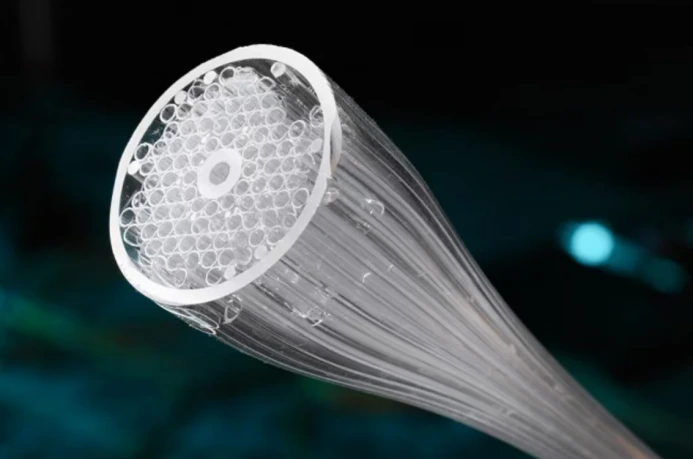
Différences entre les fibres à âme creuse et à âme pleine
Voici une comparaison détaillée mettant en évidence les distinctions entre la fibre optique à âme creuse et la fibre à âme pleine traditionnelle :
| Fonctionnalité | Fibre optique à noyau creux | Fibre traditionnelle à noyau solide |
| Milieu de propagation de la lumière | Air ou gaz à bas indice | Verre de silice |
| Vitesse du signal | Vitesse de la lumière proche du vide | Plus lent à cause du milieu en verre |
| Latence | Extrêmement faible | Relativement élevé |
| Effets non linéaires | Très faible | Remarquable |
| Gestion de la puissance | Élevé | Limité |
| Perte matérielle | Faible | Plus haut |
| Complexité de fabrication | Élevé | Mature et simple |
| Coût | Cher | Relativement faible |
| Applications principales | Communication à haut débit, systèmes laser | Réseaux de communication généraux |
En résumé, la fibre optique à âme creuse excelle dans les applications qui exigent une latence ultra-faible, une transmission haute puissance et une distorsion minimale du signal.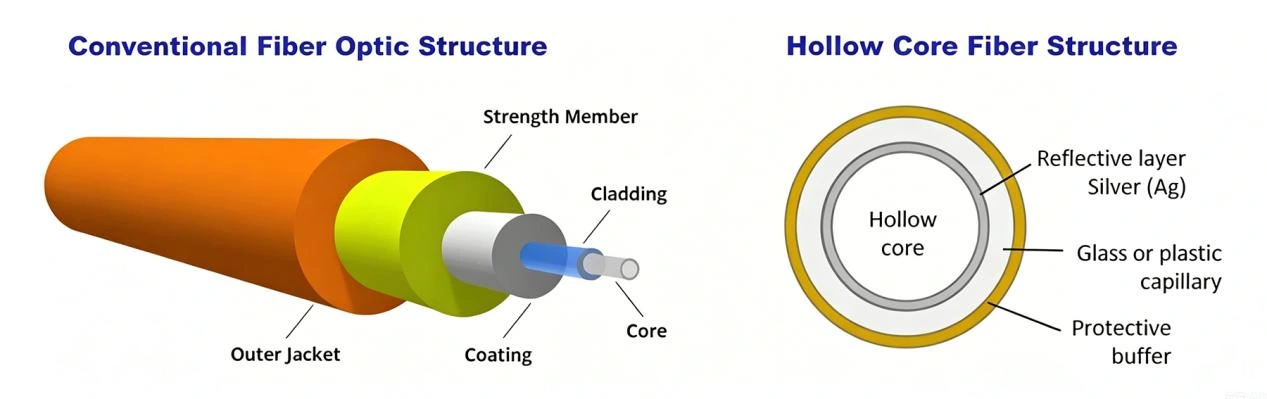
Avantages de la fibre optique à noyau creux
Délai de propagation extrêmement faible
La lumière est plus rapide dans l’air que dans le verre, ce qui signifie qu’il y aura moins de latence dans la fibre optique à âme creuse. Il est avantageux lorsqu'il est utilisé dans le trading haute fréquence, le cloud computing et les centres de données en raison des pertes de performances possibles résultant de retards de quelques microsecondes.
Non-linéarité réduite
La non-linéarité peut affecter les câbles à fibres solides en générant une auto-modulation de phase, un mélange à quatre ondes et une diffusion Raman. Cependant, étant donné que la fibre optique à âme creuse guide la plupart des ondes lumineuses via l’air intérieur, ce problème ne se pose pas et peut donc être utile pour la transmission sur de longues distances.
Capacité de puissance optique élevée
La capacité de puissance élevée des fibres optiques peut limiter leur utilisation en raison de dommages au matériau ou d'une surchauffe, mais elle n'affecte pas les fibres optiques creuses. Ses avantages incluent son utilisation dans :
- Découpe et soudage laser industriel
- Procédures médicales au laser
- Lasers ultrarapides
- Lasers de défense et d'aérospatiale
Perte de signal minimale
Les fibres creuses modernes peuvent fournir une perte de signal presque nulle, voire inférieure, par rapport aux fibres optiques monomodes traditionnelles.
Robustesse environnementale
La conception à noyau d'air offre une meilleure stabilité dans des conditions extrêmes ou difficiles, notamment :
- Forte interférence électromagnétique
- Environnements à haute ou basse température
- Zones à fort rayonnement
En conséquence, la fibre optique à âme creuse est particulièrement intéressante pour les applications aérospatiales, militaires et scientifiques.
Défis et limites
Bien que les avantages de la fibre optique à noyau creux soient nombreux, certains problèmes sont liés :
Processus de fabrication compliqué
Il devient difficile de fabriquer une fibre optique à âme creuse en raison des complexités liées à sa conception et à sa fabrication.
Coût élevé
Étant donné que les fibres optiques à âme creuse sont plus complexes et ont de faibles volumes de production, leur coût sera plus élevé que celui des autres fibres.
Compatibilité et interconnexion
L'interconnexion de fibres optiques creuses avec des fibres classiques pose certains problèmes tels que :
- Pertes d'épissage
- Problèmes de correspondance de mode
- Compatibilité au niveau de l'interface
Tout cela nécessiterait des outils et des compétences spécifiques.
Nouvelle technologie
Bien que cette technologie semble prometteuse, son utilisation industrielle est encore relativement nouvelle. Les techniques de normalisation et de production de masse doivent encore être développées.
Applications de la fibre optique à noyau creux
Applications de centre de données
En raison des besoins croissants en matière de transferts de données à faible latence et à haut débit, la fibre optique creuse est devenue un concurrent sérieux en termes d'interconnexions des centres de données.
Réseau de communication avancé
La fibre optique à noyau creux pourrait être utilisée dans les futurs réseaux 6G ou tout autre réseau ultra-rapide en raison de sa capacité à prendre en charge la bande passante requise et le transfert rapide des informations.
Aérospatiale et militaire
Lorsqu'il est nécessaire d'effectuer des opérations de communication et de détection dans des environnements difficiles, les fibres creuses s'avèrent extrêmement utiles pour :
- Systèmes de communication par satellite
- Détection dans l'espace et à haute altitude
- Communications optiques militaires

FAQ
Q 1 : Quel est le principal avantage de la fibre optique à âme creuse ?
A1 : Il offre une faible latence et une non-linéarité. Il convient donc à la transmission de données à grande vitesse et aux lasers.
Q2 : Est-ce qu'il remplace d'autres fibres ?
R2 : Non, car les traditionnels sont moins chers et ont atteint leur pleine maturité technologique. Cependant, ils conviennent à des utilisations spécialisées à forte valeur ajoutée.
Q3 : Les fibres à âme creuse peuvent-elles transmettre des signaux sur de longues distances ?
R3 : Oui, car la réduction de l’atténuation rend leur utilisation sur de longues distances de plus en plus réalisable.
Q4 : Pourquoi les fibres creuses coûtent-elles plus cher que les fibres ordinaires ?
R4 : Ils nécessitent une fabrication complexe et sont produits à petite échelle.
Conclusion
La fibre optique à âme creuse est considérée comme une technologie révolutionnaire dans le domaine de la transmission optique. Ce type de fibre innovant est capable d'offrir une latence extrêmement faible, des non-linéarités minimisées et une capacité de puissance accrue dans de nombreuses applications, notamment les réseaux informatiques haut de gamme et les appareils laser médicaux, entre autres.
Même si cette technologie présente certains inconvénients tels que des dépenses de production accrues et un manque de connectivité, des progrès constants ont permis de surmonter la plupart de ces obstacles. Par conséquent, les fibres optiques à âme creuse devraient devenir un aspect important de l’industrie des réseaux optiques de demain.
Pour toutes les entreprises et les chercheurs à la recherche de produits optiques avancés, à haut débit et à haute puissance, explorant les fibres optiques à âme creuse provenant de fournisseurs réputés tels que MOC peut être très bénéfique.